

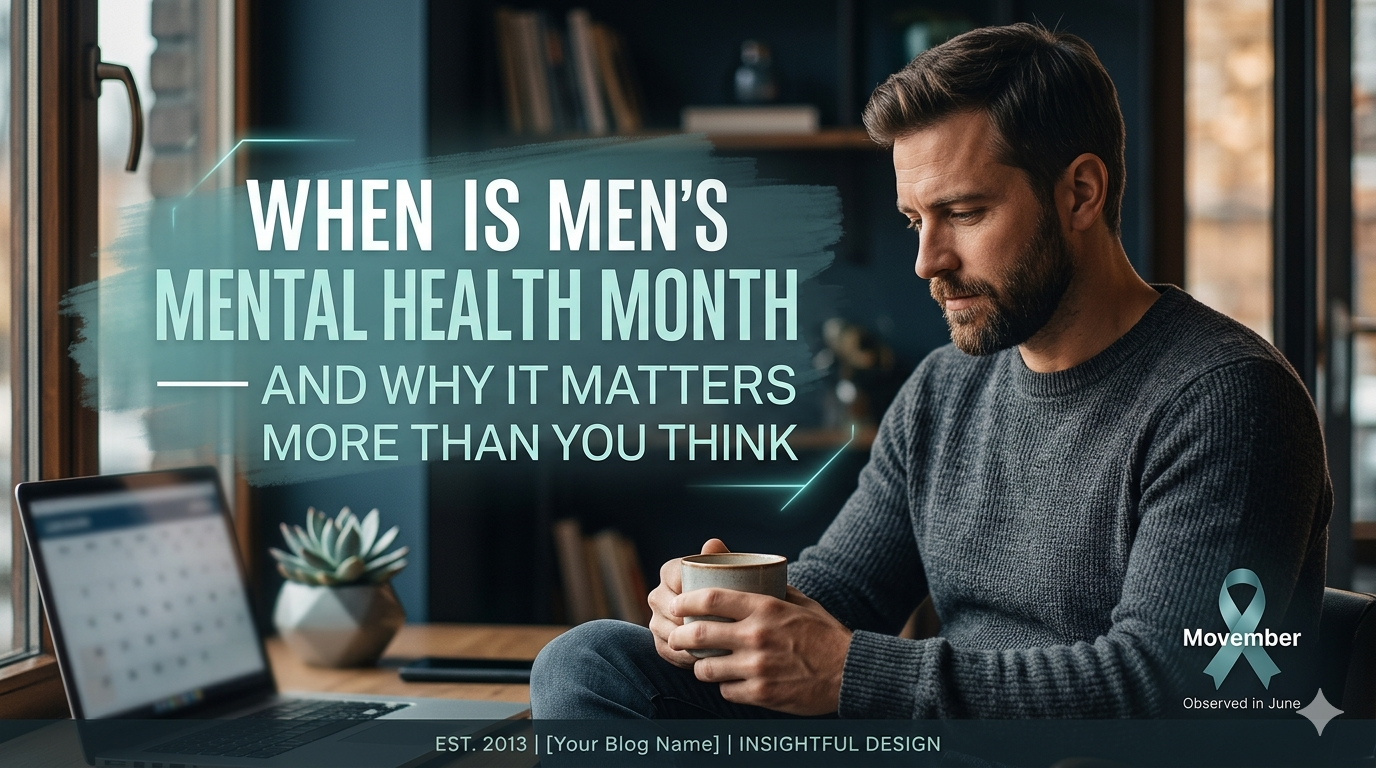
Wondering when Men’s Mental Health Month is? It’s June — and here’s why it matters, what happens during it, and how to actually make use of it. Real talk, no fluff.
Most guys I know don’t talk about mental health. Not because they don’t struggle, but because nobody ever told them it was okay to. I was one of those guys for a long time, honestly.
So when I first started paying attention to Men’s Mental Health Month, I didn’t expect it to hit as close to home as it did. But here we are.
When Is Men’s Mental Health Month, Exactly?
Men’s Mental Health Month is observed every June in the United States. It runs the entire month, with awareness efforts, campaigns, and community events spread throughout.
You might also hear about Movember — that’s the moustache-growing campaign every November, which focuses heavily on men’s mental health alongside prostate and testicular cancer awareness. So in a way, men get two months. But June is the official one.
There’s also Men’s Health Week, which falls in the third week of June, typically leading up to Father’s Day. That timing is intentional — Father’s Day creates a natural opening to talk about the emotional wellbeing of the men in our lives.
I remember the first time I saw a “Men’s Mental Health Month” post online and thought, “wait, that’s actually a thing?” Took me longer than I’d like to admit to realize how much awareness infrastructure exists around this topic that most of us just… never hear about.
Why Men’s Mental Health Deserves Its Own Month
Here’s the thing — mental health awareness in general has grown a lot over the past decade. But men still fall through the cracks at alarming rates.
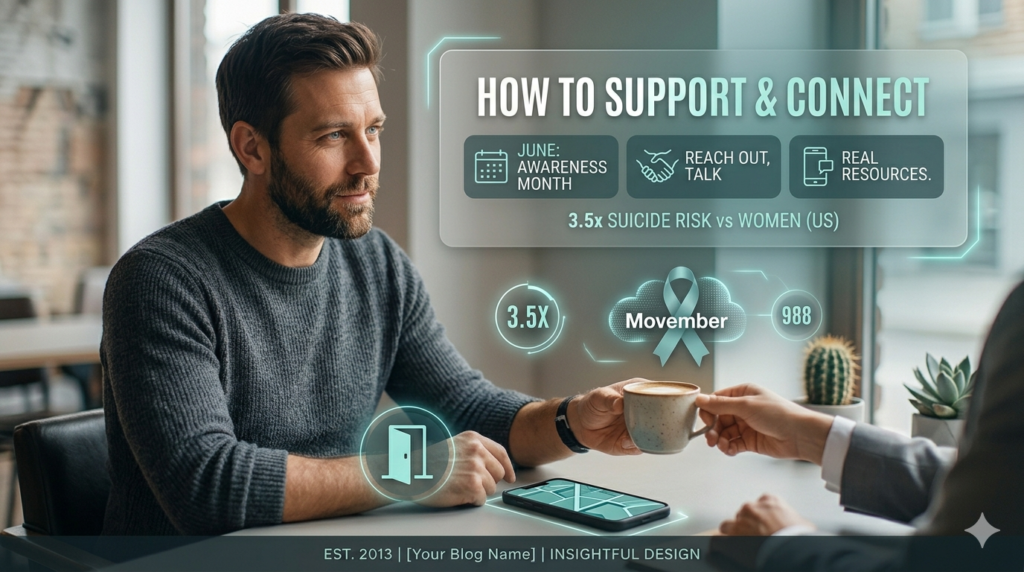
According to the American Foundation for Suicide Prevention, men die by suicide at roughly 3.5 times the rate of women. That stat stopped me cold when I first read it. And yet men are far less likely to seek therapy, talk to a doctor, or even acknowledge they’re struggling.
Sound familiar? Yeah, I’ve been there too.
Part of it is cultural. Boys are taught early that showing vulnerability is weakness. That “manning up” means pushing through. And so a lot of us spend years — sometimes decades — bottling things up until something breaks.
Men’s Mental Health Month exists specifically to push back on that. It’s a dedicated window to normalize the conversation, reduce stigma, and remind men that asking for help isn’t a failure. It’s actually the harder thing to do.
What Happens During Men’s Mental Health Month
Awareness Campaigns and Events
June brings a wave of campaigns from mental health organizations, workplaces, schools, and online communities. The Movember Foundation, Mental Health America, and NAMI (National Alliance on Mental Illness) all ramp up their outreach during this period.
A lot of it happens online now — Instagram stories, Twitter threads, YouTube videos from men sharing their experiences. From what I’ve seen, the peer storytelling stuff tends to land harder than the clinical messaging. There’s something about hearing another guy say “I went through this” that cuts through in a way that pamphlets just don’t.
Workplace Mental Health Initiatives
A growing number of companies use June to roll out mental health resources — things like EAP (Employee Assistance Program) reminders, lunch-and-learns, or just internal conversations that wouldn’t normally happen. Not all of it is deep, but getting the conversation started somewhere is still something.
My team did one of these a couple years back — a small group check-in that our manager framed as optional. Half the team showed up. And the conversation that happened was surprisingly real for a Tuesday afternoon work meeting.
The Movember Crossover
Even though Movember technically runs in November, a lot of its advocacy work bleeds into June because the issues overlap. Their “Mo Bros” community stays active year-round, and many of the mental health resources they publish get reshared during Men’s Mental Health Month. It’s worth bookmarking their site if this stuff matters to you.
The Real State of Men’s Mental Health (It’s Not Great)
I’ll be upfront — I was skeptical at first that dedicated awareness months actually changed anything. And honestly? The skepticism isn’t entirely wrong.
Awareness alone doesn’t fix a healthcare system that’s underfunded in mental health services. It doesn’t undo years of socialization telling men their emotions are inconvenient. But it does create permission structures — small cultural moments where it becomes slightly more acceptable to say “I’m not doing okay.”
And those moments compound over time.
Here are some things worth knowing:
- Men are less likely to be diagnosed with depression, not because they experience it less, but because it often presents differently — as irritability, risk-taking behavior, substance use, or withdrawal rather than sadness
- About 6 million men in the US are affected by depression each year, according to Mental Health America
- Men are significantly less likely to seek professional help — studies suggest only around 1 in 3 men with a mental health condition will get treatment
The “strong, silent” archetype isn’t just a cliché. It’s genuinely costing lives.
How to Actually Observe Men’s Mental Health Month

For Men Themselves
If you’re reading this and something’s been sitting heavy, June is as good a time as any to do something about it. You don’t have to jump straight to therapy if that feels like a leap. Start small:
- Text a friend you’ve been meaning to check in with
- Look up what your insurance covers for mental health visits (most cover more than people realize)
- Read or listen to one story from someone else who’s been through it
I once spent three weeks telling myself I’d “look into therapy” before I actually booked an appointment. The looking-into stage is where most guys stall. Just book the thing.
For People Who Care About Men
If you’ve got a dad, brother, partner, or friend who tends to go quiet when things get heavy — June is a good excuse to reach out. You don’t need a script. “Hey, how are you actually doing?” goes further than most people think.
A friend of mine had been struggling for months before anyone directly asked. Not hinting. Not assuming. Just asked. He told me later that was the first real conversation he’d had about it. That’s how low the bar is sometimes, and that’s why the bar matters.
Sharing on Social Media (Without Making It Performative)
Look, I think the social media awareness stuff is a mixed bag. There’s real value in visibility. But there’s also a version of it that’s more about the poster feeling good than the people who need help.
If you’re going to post something for Men’s Mental Health Month, make it specific. Link to an actual resource. Share a real experience. That tends to reach the guys who actually need it more than a generic “check on your friends” graphic.
Resources Worth Knowing About
If you or someone you know is dealing with something serious, here are a few starting points:
- 988 Suicide and Crisis Lifeline — call or text 988 (US)
- Movember Foundation — movember.com has men-specific mental health guides
- Mental Health America — mhanational.org has a screening tool and resource finder
- BetterHelp / Talkspace — online therapy options that work well for people hesitant about in-person sessions (they’re not perfect, but the accessibility helps)
Personally, I think the online therapy platforms get a bit overhyped sometimes — they’re not a replacement for serious clinical care — but for someone on the fence about starting, they lower the barrier enough that they’re worth mentioning.
Final Thoughts
Men’s Mental Health Month is June. Write it down, save it somewhere, and maybe actually do something with it this year.
The stats are grim, but the trajectory can change. Every guy who decides to have an honest conversation, book an appointment, or just admit he’s struggling shifts things a little. None of this has to be dramatic.
I’ve seen people treat this stuff like it needs to be a big breakthrough moment — some kind of cinematic realization. But usually it’s just a Tuesday where you decide to stop pretending everything’s fine. That’s enough. That’s actually how it tends to start.
If June gives you that Tuesday, use it.
FAQ
Is Men’s Mental Health Month in June or November?
June is officially recognized as Men’s Mental Health Month in the US. November features Movember, which also focuses on men’s mental health alongside physical health issues like prostate cancer — so both months carry awareness efforts, but June is the primary one.
What is the theme for Men’s Mental Health Month?
The theme varies year to year across different organizations, but the through-line is always about reducing stigma, encouraging men to seek help, and normalizing emotional expression. Check Mental Health America or the Movember Foundation in June for that year’s specific campaigns.
How can I support Men’s Mental Health Month?
Start with the people around you. Check in with the men in your life — not a passive “you good?” but an actual conversation. Share credible resources online. Donate to organizations like NAMI or Movember if you’re able. And if you’re a man yourself, using the month as an excuse to finally book that therapy appointment is a completely valid form of participation.
Why do men struggle to talk about mental health?
A mix of cultural conditioning, social expectations, and a healthcare system that historically hasn’t been great at identifying male depression. Men are often socialized to equate emotional expression with weakness, which makes asking for help feel like a personal failure rather than a smart decision. Awareness months like this one exist partly to chip away at that framing over time.
